 Avalaunch
 allocations for stakers under sale caps
Avalaunch allocations give eligible registrants a purchase allowance in an initial decentralized offering, or IDO, on Avalanche. XAVA stakes and XAVA Points shape allocation power, while sale size, competing eligible stakes, and a per-sale cap constrain purchases. Registration, payment, and token release have separate conditions.
In short: A sale cap limits the purchase allowance even when additional XAVA Points increase a staker’s allocation power.
Registration and the balance that qualifies
Staking Round access requires approved know your customer (KYC) verification, a verified Avalanche C-Chain wallet, and XAVA in the allocation staking pool. The sale’s geographic exclusions also apply.
Sale registration
Eligibility permits registration during the sale’s registration window. Confirming the selected round fixes that choice for that IDO; qualifying for both the Validator Round and Staking Round does not permit entering both. The optional Booster Round follows the Staking Round under separate opt-in rules.
Validator access
The validator route requires approved KYC, a verified C-Chain wallet, verified node ownership, and an active node during registration and the sale. A January 16, 2024 extension admitted eligible GoGoPool minipool operators after ownership verification through KYC before sale registration. They had to register with the wallet associated with their minipool. Those operators did not need to hold or stake XAVA for this route.
Separate Gold Staker sales
Battle for Giostone’s September 2022 Dual-IDO used separate Community and Gold Staker registrations. Gold eligibility counted twelve-month locked tokens present at the September 21, 2022, 02:00 UTC snapshot. The Community sale counted locked and unlocked stake. Eligible participants could use the qualifying stake in both sales without dividing it.
Why can a larger XAVA stake produce a small allocation?
A larger stake increases allocation power within a sale whose available tokens and maximum allowance limit individual purchases. Registered participation affects how that available allocation spreads across eligible accounts.
A sale’s maximum allocation limits the purchase allowance for each verified account. An estimate remains sensitive to the amount available for sale, the number of registered users, and their qualifying stakes. A balance that supports one allowance in one sale does not establish the same allowance in another; multiplying an earlier purchase amount by a stake increase would ignore those changing inputs.
Guaranteed allocation means an eligible registrant has a reserved purchasing opportunity during the applicable round. The token price converts a purchase amount into project tokens; the project’s release schedule determines when those tokens become claimable.
XAVA Points add weight without fixing the purchase amount
XAVA Points, or XP, express allocation power; they have no direct one-for-one conversion into the project tokens offered in a sale.
Staked tokens and earned rewards
The staking model assigns one XP per staked XAVA. Earned XAVA must enter the staking contract before it contributes toward future allocations, and the compounder handles that redeposit. Compounding also incurs the applicable new-deposit fee. XP itself cannot be bought or traded.
Fixed-term locking
Under the October 31, 2021 schedule, locked XAVA receives a 1.3x XP multiplier for three months, 1.5x for six months, and 2x for twelve months. The selected term prevents early unlocking, so a larger XP balance comes with a commitment of the underlying tokens. The extra XP expires when that XAVA is unlocked.
A hypothetical lock and the registration boundary
Consider a hypothetical balance already credited for locking after any deposit fee. Locked XAVA: 724. Apply the three-month multiplier of 1.3 from the October 31, 2021 schedule. The formula is
XP = locked_xava * 1.3
. Total allocation power:
941.2 XP. The lock adds 217.2 XP above the allocation weight of the same unlocked stake. This calculation establishes allocation weight, without specifying a project-token quantity or a dollar purchase allowance.
Assume approved KYC and a verified wallet. With registration confirmed before its deadline, wait for the selected round and use its displayed allowance as the purchase ceiling. If registration was missed, the extra points cannot reopen access to that sale. Stop that purchase attempt; a later IDO requires its own registration.
Fees and locked capital change the cost of access
The allowance measures purchasing access, while staking charges and withdrawal constraints affect the capital committed to obtaining it.
The August 30, 2021 staking terms deduct a 2% fee from each new XAVA deposit, including compounded rewards. A separate allocation fee equals 2% of the allocation’s purchase value, collected in XAVA. Its base is the allocation value, distinct from the number of XAVA tokens deposited. Those terms allow fee changes, so these figures describe the published schedule rather than an immutable price.
Registering for the Staking Round locks the total stake until the sale completes. A voluntary fixed-term XAVA lock can last longer. Sale completion does not shorten that separate commitment.
The November 16, 2021 cooldown terms apply to IDO registrants, with an unstaking fee paid in XAVA. The schedule starts at 15% when the sale ends and declines linearly to zero over fifteen days. Stakers who did not register for the IDO fall outside that cooldown rule. Waiting out a cooldown also does not release XAVA before a chosen fixed-term lock expires.
Can the Booster Round increase my allocation?
The Booster Round can add a purchase after the Staking Round when unsold tokens remain and an opted-in participant has funding. The October 31, 2021 automation terms process opted-in stakers by stake, highest first, drawing purchases from the remaining token supply. Being in that queue therefore does not establish that tokens will remain when a particular participant’s turn arrives.
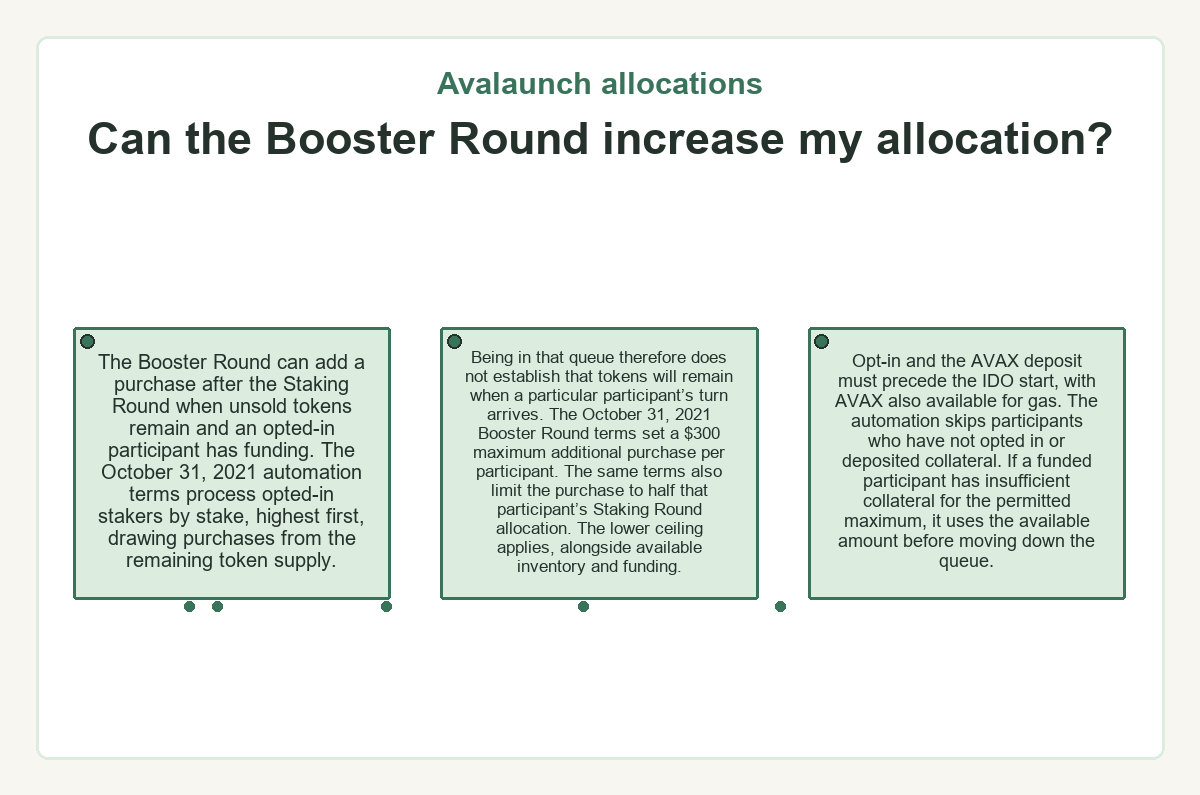
The October 31, 2021 Booster Round terms set a $300 maximum additional purchase per participant. The same terms also limit the purchase to half that participant’s Staking Round allocation. The lower ceiling applies, alongside available inventory and funding. Opt-in and the AVAX deposit must precede the IDO start, with AVAX also available for gas. The automation skips participants who have not opted in or deposited collateral. If a funded participant has insufficient collateral for the permitted maximum, it uses the available amount before moving down the queue.
Auto-Buy uses AVAX for the reserved purchase
Auto-Buy purchases the reserved allocation during the sale window when enabled and adequately funded; it does not create additional allocation power. The Automations tab gives AVAX collateral recommendations based on the stake and predicted allowance. Funding must cover the purchase and transaction costs. Auto-Buy can be enabled before the sale starts, including after registration. Once the sale begins, the documented setup does not allow disabling it. Its purpose differs from the Booster Round, which seeks an additional purchase from leftover tokens.
A sale allowance versus a later vesting purchase
An IDO allocation provides entry at the sale’s token price, with release dates that may extend beyond the purchase. A total allocation can include future portions, so the whole position need not be immediately claimable. The dashboard distinguishes the position from tokens that have reached their release dates.
Supported vesting claims offer a later way to acquire the right to future project tokens through the marketplace. Marketplace support began with Deepwaters in February 2023 and excludes earlier sales. The purchase price follows the marketplace offer, while the acquired claim retains its release schedule. Choosing between an IDO allowance and a later vesting purchase therefore involves different entry prices and availability windows.
Helpful answers
Does reaching an IDO cap also cap my share of redistributed XAVA fees?
An IDO purchase cap does not set the same ceiling on staking fee redistribution. The staking model distributes rewards relative to the XAVA stake. A larger position can therefore affect its share of those distributions even when the sale’s maximum already limits its token purchase allowance.
When does Avalaunch set the maximum allocation for a sale?
The allocation-setting process sets the sale maximum after registration closes. It evaluates qualified stakes alongside available tokens and registered participation. The ceiling applies to that sale, so a prediction made before registration finishes does not establish the final amount available to purchase.
Does staking XAVA enroll me in every future IDO?
Staking XAVA does not automatically register the wallet for every future IDO. Sale participation remains optional and requires registration for the chosen sale. Keeping XAVA in the allocation pool preserves the staking position without committing the holder to every project that launches.
Who receives the XAVA collected as an allocation fee?
The allocation fee is redistributed to XAVA stakers. The published fee model sends these charges back into staking rewards, including rewards for holders who do not enter sales. The charge belongs to the purchase’s cost; receiving future staking distributions does not establish that an individual will recover that expense.
Does a Staking Round allocation require a fixed minimum XAVA tier?
The published Staking Round eligibility terms specify no minimum XAVA stake. Approved KYC, a verified C-Chain wallet, allocation staking, and timely registration still apply. The absence of a minimum tier does not promise a particular purchase amount; sale size, qualifying stakes, and the per-sale maximum govern that allowance.